The Citation CJ series has built its reputation around a relatively straightforward formula: light-jet performance, efficient operation, and an airframe that has continued to evolve through several generations. Maintenance follows a similar philosophy, but the inspection program is more involved than simply bringing the airplane in once a year for an “annual.”
CJ maintenance is organized around a continuous inspection program. Depending on the aircraft, individual requirements may be triggered by flight hours, calendar time, landings, or component-specific limitations. Some occur frequently and involve a relatively limited portion of the airplane. Others involve considerably more access and inspection work, and additional structural requirements come into play as the aircraft accumulates time.
The other thing CJ owners quickly discover is that Inspection Document numbers aren’t universal across the series. A Doc number on a CJ1 doesn’t necessarily identify the same work on a CJ3 or CJ4. The 525, 525A, 525B, and 525C each have their own applicable maintenance programs, so understanding the interval and scope of an inspection is ultimately more useful than simply knowing its Doc number. The CJ4 program, for example, is built primarily around calendar periods and flight-hour intervals divisible by 400 hours.
For owners, long-term maintenance planning means understanding both the routine inspection cycle and the larger events that are approaching several years or several thousand hours down the road.
How CJ inspections work
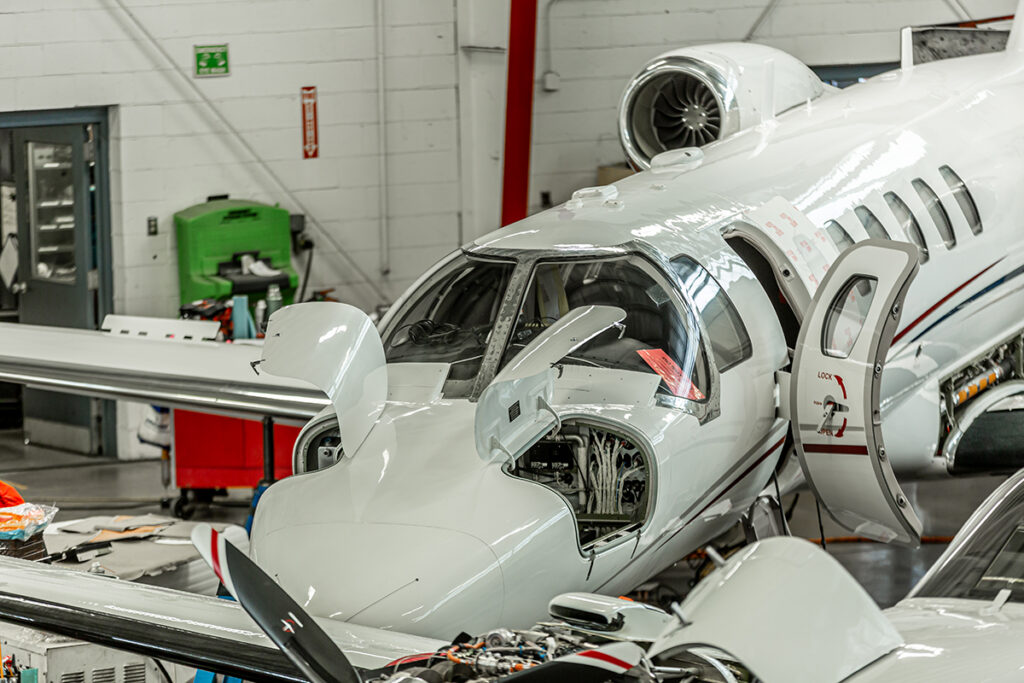
The CJ series uses a continuous inspection program rather than the traditional annual-inspection approach familiar to many owners coming from piston aircraft. For turbine aircraft, the maintenance picture also includes an airworthiness limitations section, containing mandatory inspections and part-replacement limits.
On the CJ1, for example, several inspection documents come due based on combinations of hours and calendar time. Some requirements occur at 300 hours, while others come due at 12, 24, or 36 months. There are also requirements that don’t align neatly with that basic cycle, including component-specific and higher-time structural inspections.
The CJ3 follows the same general continuous-inspection philosophy, but its inspection document numbers and individual requirements are different. Its schedule includes 300-hour inspections, 12- and 24-month requirements, a 1,200-hour/36-month airframe inspection and separate higher-time structural inspections.
This is why saying a CJ is “fresh from inspection” only tells part of the story. What was accomplished, what’s due next and where the airplane sits in the rest of its maintenance program provide a much better picture.
Routine CJ Inspections
Routine CJ maintenance is a combination of smaller recurring inspections and larger scheduled events. The exact Doc numbers change between models, but the inspection program typically brings the airplane back to maintenance based on both utilization and calendar time.
Using the CJ1 as an example, its schedule includes a 300-hour Doc 1, a 300-hour/24-month Doc 8 airframe inspection, and a number of 12- and 24-month requirements. The larger Doc 10 complete inspection comes due at 1,200 hours or 36 months.
The CJ3 schedule illustrates why the Doc number itself can’t be carried from one model to another. Its Doc 1 is also a 300-hour inspection, but its larger 1,200-hour/36-month airframe event is Doc 22 rather than Doc 10. Its pitot-static-related inspection is Doc 18 at 24 months, while on the CJ1 that requirement appears as Doc 13.
There are also smaller items that can fall outside the headline inspection event. Battery and corrosion inspections are good examples. Maintenance providers identify separate corrosion and battery requirements for the CJ, CJ1/CJ1+, CJ2/CJ2+, CJ3/CJ3+ and CJ4, with the applicable Doc numbers changing between models.
Rather than thinking of these as separate maintenance events, it is more useful to look at the airplane’s complete due list and determine which requirements will converge during the same shop visit.
How CJ Inspection Schedules Differ
The CJ1, CJ2, CJ3, and CJ4 share the same basic approach to continuous maintenance, but they shouldn’t be treated as if they share one inspection schedule.
Aircraft | Model | General inspection approach | Example of a significant recurring inspection |
CJ / CJ1 / CJ1+ | 525 | Hourly and calendar-based continuous inspections | Doc 10 complete inspection at 1,200 hours / 36 months |
CJ2 / CJ2+ | 525A | Model-specific continuous inspection program | Uses its own 525A Inspection documents and intervals |
CJ3 / CJ3+ | 525B | Hourly and calendar-based continuous inspections | Doc 22 airframe inspection at 1,200 hours / 36 months |
CJ4 | 525C | Primarily calendar intervals and hours divisible by 400 | Model-specific 525C inspection program |
The important part of this table isn’t memorizing the different Doc numbers. It’s recognizing that an owner moving from one CJ model to another shouldn’t assume that familiar Doc numbers, intervals, or scopes transfer to the newer aircraft.
Major Recurring Inspections Across the CJ Series
The larger recurring inspections don’t carry the same Document number throughout the CJ series. On the CJ1 and CJ1+, Doc 10 is the Complete Inspection and comes due at 1,200 hours or 36 months. The CJ2 and CJ2+ use the same Doc 10 designation and the same 1,200-hour/36-month interval for their Complete Inspection.
Move to the CJ3 and the numbering changes. Its major 1,200-hour/36-month Airframe Inspection is Doc 22 rather than Doc 10. The CJ4 uses a different maintenance rhythm, with its inspection program built around calendar requirements and flight-hour intervals that generally fall in 400-hour increments.
Aircraft | Major recurring inspection |
CJ1 / CJ1+ | Doc 10: Complete Inspection, 1,200 hours / 36 months |
CJ2 / CJ2+ | Doc 10: Complete Inspection, 1,200 hours / 36 months |
CJ3 / CJ3+ | Doc 22: Airframe Inspection, 1,200 hours / 36 months |
CJ4 | 525C-specific inspection program, generally built around calendar intervals and 400-hour increments |
For owners, the Doc number is less useful than understanding what the inspection involves and where it falls within the airplane’s overall maintenance schedule. A major inspection may also coincide with calendar items, engine requirements, landing gear work or other maintenance, so two aircraft going through the same headline inspection can still have very different work scopes.
Higher-Time Structural Inspections
The normal recurring Doc inspections aren’t the end of the maintenance schedule. As CJs accumulate hours and landings, additional structural inspections come due. These can involve cabin and fuselage skins, pressure bulkheads, doors and window structure, engine-mount structure, spars and empennage components. The exact requirements and intervals vary by model and, in some cases, serial number.
Rather than treating these as another “major” that happens at one specific time, they are better viewed as a progression. Some structural requirements begin relatively early in an airplane’s life, while others don’t appear until considerably higher aircraft times.
The schedules for the CJ1 and CJ3 show how that progression can differ:
Aircraft | How higher-time structural inspections progress |
CJ / CJ1 / CJ1+ | Cabin-skin NDT appears at 1,200 hours, with additional structural requirements at 6,000, 7,200 hours and beyond. Some later requirements differ by serial number. |
CJ2 / CJ2+ | The 525A has its own series of structural inspections at progressively higher aircraft times and landing counts. |
CJ3 / CJ3+ | Structural requirements begin appearing by 1,500 hours, with additional inspections at 2,000, 2,500, 3,000, 5,000 hours and beyond. Higher-time requirements include specified eddy-current inspections. |
CJ4 | Higher-time structural requirements are governed by the 525C maintenance program and applicable airworthiness limitations. |
The practical effect becomes more noticeable as an airplane accumulates time. Two CJs can both be completely current on their recurring inspections while sitting at very different places in their structural inspection programs. A higher-time airplane, or one that lives in a more corrosive environment, may have significant inspections approaching even though its most recent major recurring inspection has already been completed.
This is particularly relevant when evaluating an aircraft for purchase. Total time isn’t simply a measure of utilization or resale value. It also helps determine which structural inspections are approaching.
Landings Matter Too
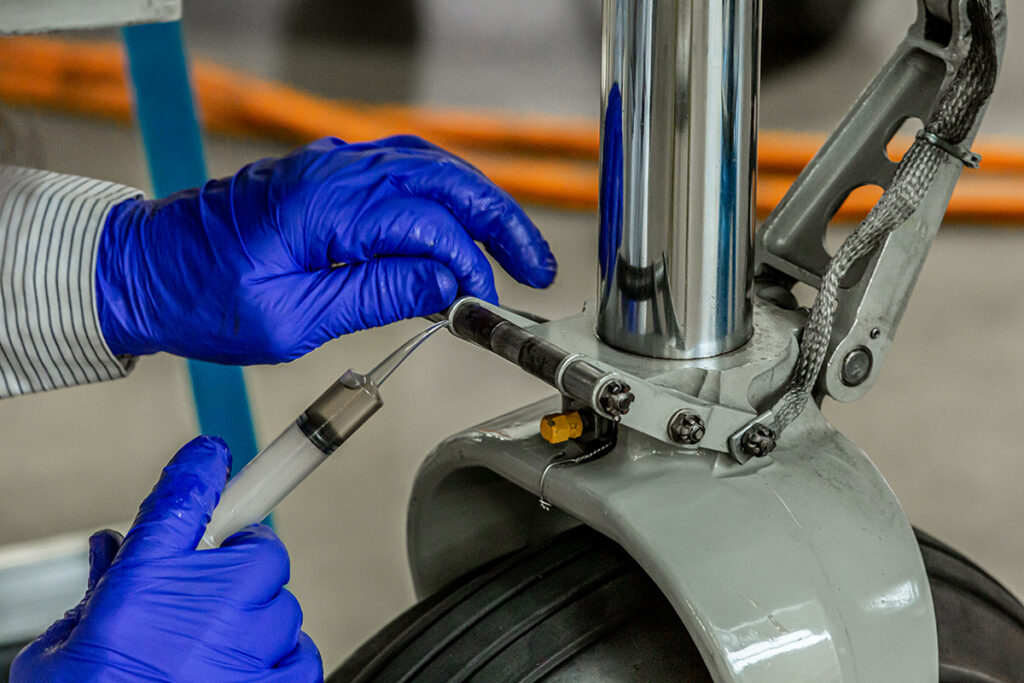
Not every maintenance requirement is driven by aircraft hours or calendar time. Some are based on landings, which adds another variable when comparing aircraft. For example, both the CJ1 and CJ3 schedules include a nose landing gear inspection at 5,000 landings, followed by inspections every 1,000 landings thereafter.
Two aircraft with similar total time can have very different landing counts depending on how they have been operated. A CJ that regularly flies shorter trips can accumulate landings faster relative to its total flight hours than an airplane used primarily for longer missions.
Looking at hours without considering landings can therefore leave part of the upcoming maintenance picture out of the forecast.
Engines Have Their Own Schedule
The airframe inspection program is only one part of CJ maintenance. The Williams FJ44 engines have their own inspection requirements and need to be tracked independently from the airframe Docs.
The specific intervals vary by engine and aircraft application. This means completing a major airframe inspection doesn’t automatically reset the maintenance clock on the engines. An aircraft can legitimately be described as fresh from its major airframe inspection while still having engine maintenance approaching.
When planning a shop visit, the engine schedule should be evaluated alongside the airframe schedule so the owner has a complete view of what is coming due.
Don't Overlook the Smaller Calendar Items
The major inspections get most of the attention, but CJ maintenance also includes smaller requirements that continue to come due between those larger events. Depending on the model, these can include inspections involving batteries, corrosion, emergency equipment, ELTs, fire extinguishers, windows and windshields, landing gear, and other aircraft systems. Their Inspection Document numbers aren’t necessarily consistent from one CJ model to another.
These requirements also don’t always line up neatly with the airplane’s larger inspections. A lower-utilization aircraft can become particularly calendar-driven, with 12-, 24-, or other calendar-controlled items coming due well before the airplane reaches its next significant hourly inspection.
This is why maintenance planning works better when the due list is viewed as a whole rather than simply tracking the airplane from one major Doc inspection to the next.
Planning Around a Major Inspection
A larger inspection provides a logical opportunity to look at what else is approaching. If another inspection or component requirement will become due shortly afterward, the owner and maintenance provider can evaluate whether accomplishing it during the same visit makes sense.
Utilization plays a large role in that decision. An airplane flying 500 hours annually will move through hourly requirements much differently than one flying 150 hours annually. A lower-utilization aircraft may reach calendar limits first, while frequent shorter trips can make landing-driven requirements more relevant.
Combining maintenance isn’t automatically the right answer. Accomplishing something substantially ahead of schedule can give away useful remaining time. The objective is to understand the upcoming requirements well enough to decide which work makes sense to combine and which work is better left for a later visit.
Buying a CJ? Look Beyond the “Fresh Major”
“Fresh major inspection” is useful information in an aircraft listing, but it doesn’t tell a buyer everything about the maintenance position of the airplane.
Consider two otherwise comparable CJs. One may have just completed its Doc 10 or other major recurring inspection but be approaching higher-time structural, engine or landing-driven requirements. Another airplane may be farther removed from its major inspection while having fewer significant events immediately ahead.
A buyer trying to understand the actual maintenance outlook should look at four areas:
- Hourly, calendar, and landing requirements: What’s coming due based on how the aircraft will actually be flown?
- Higher-time structural requirements: Where does the airplane sit within the structural inspection program applicable to that model and serial number?
- Engines and major components: What significant maintenance is approaching independently of the airframe inspection schedule?
- The multiyear forecast: What comes after the next scheduled inspection?
That last view can change how two airplanes compare. Maintenance status shouldn’t be judged solely by how recently an airplane completed its largest recognizable inspection. What comes next can be just as important.
Building a Better CJ Maintenance Plan
CJ maintenance becomes easier to understand once the individual Doc numbers are put into context. The CJ1, CJ2, CJ3, and CJ4 share the basic philosophy of continuous inspection, but they don’t share one universal schedule. The applicable requirements depend on the model, serial number, aircraft time, landings, and component status.
For an owner, maintenance planning should start with those facts and then look forward. Smaller hourly and calendar inspections can be mapped against the larger recurring events, while engine, component, and higher-time structural requirements can be added to the same forecast.
That provides a much better picture than simply asking when the next major inspection is due. A CJ that is completely current today can have a very different maintenance outlook from another CJ that is equally current. Looking several years ahead helps owners understand upcoming downtime, determine where maintenance can reasonably be combined, and make more informed decisions when buying, selling or continuing to operate the aircraft.